
The segregation is a process, for which components of granular mixtures at its transportation, unloading, crushing blending, mixing, drying and other technological operations, move in opposite directions.
The segregation of loose materials and their solutions is defined by change of a physical condition of the unhomogeneous mediums consisting of particles of any shape, various densities and sizes.
Until now the theory of a segregation of particles and their solutions is insufficiently developed. Therefore regularity of segregation is defined, in the core, experimentally. It does not allow the precise operational process of segregation and to forecast its results.
Results of experimental researches of process of a segregation of various loose materials and their solutions are presented in numerous papers and books. Their short analysis has defined the basic features and regularity of the studied phenomenon.
So, in solutions of various loose materials the following phenomena and problems occur.
The segregation in solutions is characterized by a non-uniform particle size distribution, to shapes, density and other physic mechanical properties.
For example, in road concrete mix which is used for coverage of roads, the segregation leads to non-uniform distribution of components in a solution. It leads to deterioration of coverage of roads and their premature deterioration. Such deficiency is eliminated by intensive mixing of mixture and other organizational provisions on placement of coverage of roads.
Similar problems occur in solutions of metals (non-uniform density of impurities in solution volume diminishes strength of materials, especially at welding of surfaces, augments its friability, etc.), in mixtures for production of cement, concrete and other technological processes.
The segregation of loose materials essentially influences efficiency of process of their handling and the further use. For example, because of segregation in mixed mixture the demand of uniform distribution of its components on all volume of a processed product is disturbed. One possible solution to this problem is preliminary refinement of components of a processed product before deriving of particles on sizes of one order if the subsequent processes do not restrict their sizes.
The segregation’s ill effect is manifested in deterioration of a carried granular material especially at its loading and unloading to places of subsequent technological use. Thus large and heavy particles roll down to the bottom of a bin outlet or to a foundation of an unloading material. Thus, there is a natural separation of particles on coarseness, i.e. the lower stratums are filled by particles of large sizes.
One of possible solutions of this problem is the application of mixing devices that leads to additional material expenses. For prevention of a natural segregation at the unloading of particles from a dump truck distribution of an unloading material not in one place, and on the square of its foundation is necessary.
In certain cases the segregation is useful, for example, at a screen sizing of loose materials, their fluidization and other similar processes when the loose material is being scrubbed under vibration or from a flow of air blowing through the processed loose material. Such processes occur in gravitational processes such as a dynamic jigging, vibration, transportation driving in contracting chutes, screening of particles in holes of sieves, etc.
Particles are separated in holes of sieves of the sifters installed in their tiers. Before screening under the influence of vibrations particles are arranged on layer thickness depending on their density, sizes and the shape. Particles of the greatest density concentrate remain in the lower layers. Mixtures of large and small particles are placed over the lower layers. In high layers large and easy particles concentrate.
The floating of large and light particles in high layers has the title «the Brazilian nut coal.
Experimentally it is defined that particles with small damp are segregated more intensively, than for dry mixtures.
Speed of stratification because of segregation is augmented with rising of particle size and differences of their density, and also with increase in intensity of vibrations and decrease of thickness of layer.
Most intensively this process occurs for fine particles of the spherical shape, sizes less than 500 micron for the granular loosened mixture without agglomerates. At vibration (dynamic effect) particles of the big sizes rising up, and the fine-grained material is hauled downwards to a sieving surface.
In redistributed on layer thickness, particles are concentrated to a sieve working surface in contact to it by a size smaller than the size of holes. These conditions ensure possibility of screening of these particles in holes, forming a so-called undersized product.
The big problems in practice of use of existing sifters occur at separation fine-dispersed loose materials. Their separation is carried out at vibration high-frequency modes with small amplitude of oscillations. Thus because of a small variance in sizes of holes and particles there is “a hindered” penetration of particles of undersized product into holes of sieves to the big extent of their “driving down”.
Common fault of existing sifters is their poor quality of operation on machining fine-dispersed and especially damp loose materials.
One of RING Projects Ltd’s area of activity was perfecting existing and development of new production engineering and devices for vibration transportation and separations of loose materials, especially on a screen sizing fine-dispersed dusts.
In the results of analysis of existing process engineering and devices for treatment of loose materials the company has defined modern demands to processes of separation of loose materials, especially fine-dispersed dusts, namely, rise of efficiency of separation and productivity of oscillating screens.
In modern constructions of sifters these demands are fractionally fulfilled at the expense of the developed square clothing when in each tier of sieves 3-4 sieves in length not less than 2.0 meters and width not less than 1.3-1.5 meters are installed. Such sizes sieve boots of modern sifters define intensive dynamic affecting (the high amplitudes and an oscillation frequency). It demands higher reliability and longevity of oscillating parts and parts sieve boots of sifters at the augmented cost of sifters. Besides, at machining of a wet granular material modern jigger are almost disabled that demands drying a material and additional expenditures for separation process.
Taking into account demands to modern and forecast sifters, RING Projects Ltd. has analyzed process and technology of driving of a granular material on vibrating clothing and screenings of particles in holes of sieves.
At fixed length sieves in tiers and oscillation frequency and amplitude particles of undersized product, being sieved in holes, continuously change properties of oversize product. Thus layer thickness of a worked stock is constantly diminished. The fixed regime of oscillations of tiers on all their square define almost rectilinear or with braking off from a working surface of sieves driving of a material in the absence of a flow on a working surface. It leads to decrease of a time of contact of particles with a surface of sieves and accordingly to decrease of efficiency of screening. Therefore, given regime of oscillations is optimum only for a small section sieves for which occurs the best to traffic conditions on a vibrating surface of a sieve and screening of undersized product in holes.
The major experimental material has displayed that the amplitude and an oscillation frequency of vibrations in a layers are diminished on its thickness. In a consequence of that intensity of segregation essentially decreases. The segregation practically stops in a thick layer on a vibrating surface. That defines increase in productivity of sifters while separation process is carried out with very low efficiency
Also it is proved experimentally that particles of undersized product on the beginning of each tier of sieves arrive with equally probable distribution on thickness of flow. For their screening in holes they should pass from an original rule to a sieve surface. Further, these corpuscles should have the maximum duration of driving and optimum kinematic parameters for their penetration into holes of sieves without “clogging” of holes.
Driving of particles of undersized product in a layer to clothing surfaces and on a surface of sieves is defined by dynamic act of oscillations in flow (inside) which rapidly “subside” at small altitude from a working surface. Thereof the time of driving of particles of undersized fraction in a layer, and on a working surface of sieves on which particles of oversized fractions concentrate is augmented. They raise difficulty screenings in holes of particles of undersized fraction. Thus efficiency of separation and quality of undersized fraction essentially decrease.
The intensification of a dynamic regime of sieves will lead to decrease of quality of operation of others sieves, installed in each tier of a separator.
Company Ring Projects Ltd. has concentrated the force to an intensification of inside layering processes in a granular material to a fluctuating surface without change of dynamic regimes of sieves. Besides, problems loosening of a worked material in a layer were solved, especially at heightened dampness of particles, increases in duration of driving of particles undersized and oversized fractions on clothing without loss of contact from their sieve’ surface.
Company Ring Projects Ltd. has developed raise of intensity of segregation on sieves the special devices fixed on a surface of sieves. These devices rise on intensity of segregation on sieves. For various layer thickness of a worked stock on each section of screen grate, the height and the shape of designed elements ensuring its intensive loosening and segregation have been defined. Distances between elements’ of the device in lengthwise and width directions is defined by properties of the worked stock, expelling “accumulation” of a material and its stopping on separate sections of sieves, and also the transportation speed control, ensuring set productivity of a separator.
Parameters of this device (altitude and a step of arrangement of elements of the offered device on width and length of decks), and also their construction are different for separate sections clothing of each tier of sifter.
For convenience projection Company has developed algorithm of parameters of devices and their arrangement on sections clothing and tiers of a sieve separator depending on sizes of holes of sieves, productivity of a jugging, efficiency of separation and quality of undersized and oversized fractions of a processed product.
One of alternatives of designed devices is presented on Fig. 1.
Each alternative of the new device is installed on clothing without change of regimes and parameters of its vibration parts. Distinctive feature of each element is topography change clothing taking into account specific properties of worked stock, conditions of screening of particles in undersized fraction and demands to quality of a finishing product.
The intensification of process of a segregation of a granular material is carried out in layers of thickness more than 3-4 sizes of particles. After concentration of particles of undersized fraction on clothing and screenings their particles differ from sizes of saves’ holes, remain the parts close to sizes of holes решет. For them occur conditions of the “hampered” screening in holes of sieves.
Continuous driving of these particles on a working surface of sieves with their turn concerning the axes and increase in duration of contact with clothing is attained by zigzag character of driving that raises probability of screening of particles in holes of sieves even under the hampered conditions of separation.
The offered topography of clothing has ensured zigzag driving of a worked stock on a working surface of sieves that has augmented duration of driving of particles of undersized fraction on a working surface of decks in their continuous driving. It has augmented efficiency of separation and quality of a finished stock (the maintenance of particles of undersized fraction made practically 99.0-100 %).
Besides, the devices of a special construction developed by the company destroy agglomerates in a granular material and eliminate driving down of holes in clothing. Sieves with new topography of a surface can process materials of heightened damp (to 8 %-12 %) that is essential advantage of offered advanced conventional and again developed sifters.
Offered by the company sieves with new topography clothing allow to gain a high-quality finite product without substitution of the existing equipment.
The further development and perfecting of designed devices for a segregation of a granular material in a layer should ensure optimum conditions of screening of particles in holes of a separating surface, taking into account change of properties of a worked stock lengthwise a tier of sifters.
Now the company continues to improve a construction of devices for a raise in efficiency of segregation in a direction of reliability of their installation on a separating surface depending on an aspect and properties of worked stocks with necessity of praise of longevity of sieves without their breakages and faults.
Other direction of operations of Ring Projects Ltd. in the field of separation of loose materials, especially fine-dispersed dusts, was mining of a separator with change in wide area of constructive and kinematic parameters.
“The package” location clothing, leaning a set of springs was the basic feature of this separator. These springs to be resulted in vibratory movement by the vibrator or system of the vibrators which have been install on the overhead cover of “package”. Basic feature of an offered construction is controlled by the high frequency and small amplitudes of oscillation directly of clothing package. It raises efficiency of penetration of particles in holes in the conditions of their “hindered” screening. Arrangement of these vibrators on top cover ensures equal execution environments of these processes on all square of clothing.
The case of “package” with sieves is installed on the additional springs fixed to a frame of a separator. This “package” fluctuates by means of the complementary vibrator with adjustable low frequency and the high amplitude of oscillation. This device is intended for a rise in intensity of a segregation of a worked stock even at augmented layer thickness that the considerable is augmented by productivity of a riddle.
Package” as an assembly has possibility to change a slope of clothing necessary for the installed regime of transportation of finely dispersed dusts on clothing, ensuring the maximum productivity at a separation high performance.
The separator, the realizing chosen directions is presented on images.
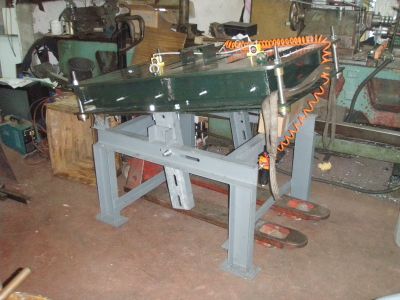
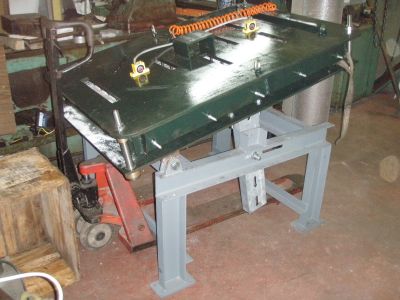
Various finely dispersed loose materials have been separated on model of an offered separator. The gained results have completely confirmed efficiency of the accepted concept of creation of new separators for separation of finely dispersed products.
The further operations in this direction, company Ring Projects Ltd. spends in the direction of searching of a setting point of vibrators on “package” for creation of uniform vibration on a surface of a sieve and searching of an optimum construction of other elements of a new separator.